❓ Answers to Your Burning Questions
Frequently Asked Questions
We get a lot of questions. These are the ones we can answer without the lawyers getting involved.
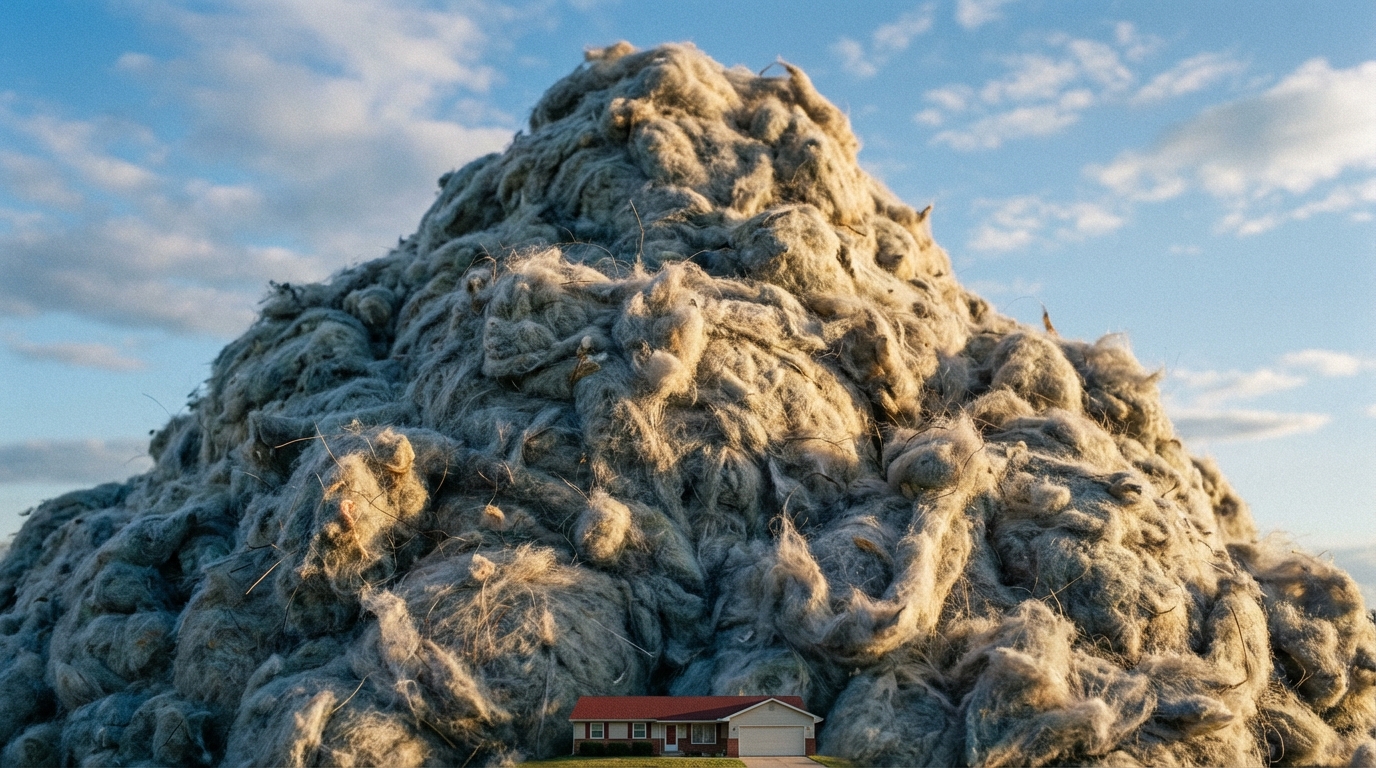
As real as the lint in your dryer right now. Go check. We'll wait. Now imagine saving that lint for 47 years. Imagine your neighbors saving it too. Imagine laundromats across the state sending weekly shipments. Now imagine all of that lint in one place, towering over a house like a fuzzy Godzilla. That's what we've got here.
Yes. Multiple astronauts have confirmed visual identification of the collection from the International Space Station (altitude: ~250 miles) without telescopic equipment. The collection's unique gray-blue coloring and sheer mass create a distinct visual signature. NASA has classified it as a "point of non-geological interest" in their Earth observation database. It's right between "Great Wall of China" and "that one guy's Christmas light display."
Lint is deceptively voluminous. A single dryer load produces roughly 1-2 grams of lint, but that lint is extremely fluffy and occupies far more space than its weight suggests. When you compound this over 47 years of personal collection, plus community donations, plus commercial laundromat partnerships, plus a few strategic bulk acquisitions from textile mills... you get a structure that is currently 186 feet tall and covers 3.7 acres. The original 2,400 square foot house looks like a garden shed next to it.
Imagine the world's coziest laundry room, amplified to a cosmic scale. Visitors consistently describe the aroma as "warm cotton," "Sunday morning," and "the scent equivalent of a hug from your grandmother." The outer layers carry a fresh, fabric-softener quality, while the deeper core has developed a more complex, earthy terroir — not unlike a fine cheese, but far fluffier. Our on-site sommelier (yes, we have a lint sommelier) offers guided olfactory tours.
We take safety very seriously. The collection is protected by a state-of-the-art suppression system including 47 industrial sprinkler towers, a 24/7 thermal monitoring network, and a dedicated fire station built specifically for the collection. The local fire department conducts monthly drills. We also maintain a 200-foot firebreak perimeter. The lint is safer than most buildings. The lint is probably safer than your house. The lint takes care of itself.
ABSOLUTELY. Lint donations are not only accepted — they are celebrated. Bring your dryer lint in any container (bag, box, mason jar, pillowcase, whatever you've got) and receive free admission. Each donor receives a numbered Certificate of Contribution, a commemorative pin, and the deep satisfaction of knowing their lint will exist for generations. Large donations (over 5 lbs) receive VIP parking.
No. Absolutely not. Every fiber is sacred. We have security cameras, lint-sniffing dogs, and a very dedicated volunteer patrol. However, the gift shop sells officially sanctioned lint samples sealed in acrylic display cases, authenticated with a certificate of origin. These make excellent gifts and have been known to increase in value over time.
When exposed to rain, the outer layer of the collection compresses slightly and forms a natural waterproof crust — similar to how a wool sweater repels light rain. Scientists call this the "felting effect." Heavy rains actually make the collection stronger. Snowfall gives it a majestic, mountain-like appearance that has been featured on several nature documentaries (most of which were confused about what they were filming).
Analysis conducted by the University of Textile Sciences (yes, that's real) shows the collection is approximately 62% cotton, 23% polyester, 8% rayon, 4% pet hair, 2% mystery fiber, and 1% hopes and dreams. The exact composition varies by layer, creating a geological record of fashion trends. The 1980s layer is noticeably more neon-tinted. The early 2000s layer contains trace amounts of glitter that no one can explain.
Acarus linteus magnificus was discovered in 2017 by entomologists from three different universities who were each independently studying the collection's ecosystem. This microscopic mite exists nowhere else on Earth. It feeds exclusively on micro-fibers and has evolved to thrive in the collection's unique microclimate. A documentary about the mite, titled "The Tiny Tenants of the Lint Kingdom," won an award at a film festival that we're told is quite prestigious.
Several attempts have been documented. A man in Ohio started collecting in 2003 but gave up after filling his basement ("too much effort"). A laundromat chain in Texas tried a corporate-sponsored collection but disbanded it after shareholders questioned the strategy. A group in Japan made an impressive attempt but pivoted to folding the lint into origami, which, while beautiful, does not count as a "collection" by official standards. Our record remains unchallenged.
The collection continues to grow at a rate of approximately 2 tons per week. Current projections suggest that by 2035, it will be visible from Mars with a decent telescope. By 2050, it may develop its own weather system. By 2100, we anticipate UNESCO World Heritage Site designation. The plan is simple: never stop. There is always more lint. There is always more wonder.
Yes.
The best way to answer your questions is to come see it for yourself. No photo, video, or FAQ can prepare you for the reality.
Plan Your Visit View Gallery